| 10.08.03 - garage - 10 - 22:00 Symposium »Unstable Systems« |
|
art without recipe - a culinary symposium
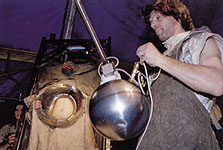
The Tactile machine is a food installation, a performance or, as Marinetti called it, a »formula« for a possible meal. The base of our »formula« is a course on and with the human body, for the guests it is also the experience of shared body. The human body is placed in the centre of the meal. The solid mechanicality and the sheltering layering of clothing are subservient to this body. The main installation parts are a solid steel frame built around a pneumatic tilting bed, or better call it a table. It's quite big and ±3 m. high. The articles of clothing, a food cannon, bionic beer arm. This dinner is now suitable for 2 guests, a couple, or lovers. One person is laying down on a tilting table and the other one is eating from this person body. At the beginning of the meal, one person steps on the bed/table and will be tilted slowly backwards. Because the tilting point is not in the middle but lower, it is giving the sensation of falling, it is a broken fall, because, halfway it becomes a table. A pneumatic cylinder causes a slow motion movement. This sensation of motion controlled falling helps reaching a mental transit state for the final handover in tenderness, to be open for the new coming experiences. The broken fall is important, as a reference to a form of detachment and a performance work of Dutch artist Bas Jan Ader who hereby physically accepted all the consequences of his choice to fall into the unknown. We create 4 courses on a human body, on 4 different spots of this body. 1. The chest, where we make a salad, salad leaves, falling down like green snowflakes out of a spinning silver tinder, get their dressing by passing through two clouds, one of olive oil and one of vinegar. 2. The stomach, where we shoot the food on. This course is build up by different layers and of heavily impact. Everything that's lovely, like food, is also connected to violence. If a human being offers himself as food, he shall have to expose himself to this violence. 3. Under the armpit, where a little steamed bread is salted with sweat after a special workout. Using the natural juice of our species. 4. On the mouth, as the dessert. A pear and its juices combine themselves with sweet dessert wine, being eaten by nothing else other than the mouths as utensils. Uniting the two bodies as final conclusion. For drinks, we serve beer opened by the Bionic Beer Hand, a violent and primitive way of opening a can. Thilges3 (Vienna/A) Associations - mobile sound installation/performance Social acoustics. What is normally understood as »examples«, becomes for Thilges3 a differentiated analysis of the place, its audience and their imagination. Entertainment loses its innocence as soon as it is confronted with the game of expectations, with positions and inconsistencies of this artistic form of expression. In August 2003 Thilges 3 will develop in Stralsund a temporary mobile installation. Their as »social acoustics« defined way of work follows traces of public life. As in their project »The open society« they consciously worked with the individual expectations of 4 different social positions (old people’s home, kindergarten, cloister, prison). The sound installation is the medium for dealing with Stralsund and its inhabitants. Live acting, but also as an autarkical, automated audio sculpture, Thilges3 will interfere with local habits. Reactions will be documented and elsewhere processed. To take account of the concept of this year’s festival, the actions and interventions will happen spontaneously. This is possible through a portable sound studio of high quality. On the last day of the festival the collected results will be put together and presented live. associations: Muezzin sings from the tower of a protestant church; in a bus the station announcement will be manipulated; fictive commercials, irritation; traffic noise on a crossing in the shopping passage. installations: hair dresser – background music for gossip from all over the world. at the butcher’s – Muzzak with natural environment, jungle, zoo, alms… > http://www.thilges.at Dr. Simon Waters - sound and delight (Norwich/UK) Simon conducts research into the relationship between music and other activities, focusing primarily on contemporary and recent musical thought and production. Examples include film, electronic technologies, material culture, and Postmodernism. He has experience working with theatre, installation and contemporary dance. As Director of the Electroacoustic Music Studios he organises concerts and other public activities within the University, in the UK, and. He has an international reputation as an electro acoustic composer, with awards and commissions in the UK and abroad, and speaks regularly at conferences (not always on music). He is currently Director of two of the AHRB-funded Research Projects hosted by the School of Music “ARiADA” (Advanced Research in Aesthetics in the Digital Arts) and SARA (Sonic Arts Research Archive).) > http://www.ariada.uea.ac.uk/ > http://www.sara.uea.ac.uk/ |
| |